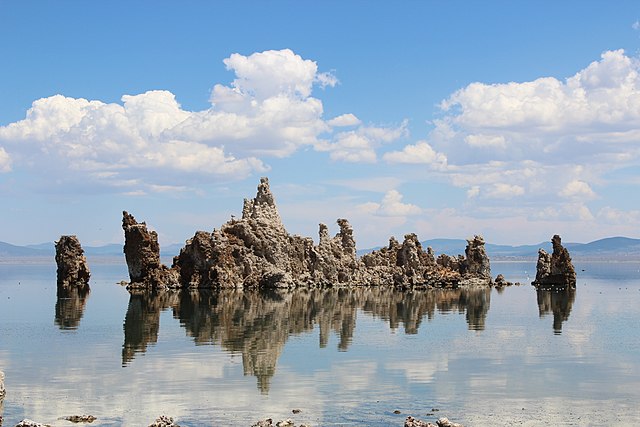
Anyway, after coffeeing up at Bridgeport, the drive to the next basin went quickly. This was to the Mono Lake endoheric basin. Again, as the crow flies, it’s only thirty miles northeast of the green and wet Yosemite Valley. I knew it would be intriguing to witness the contrast.
Although, Mark Twain said Mono Lake was like the Dead Sea – and I’d bet he didn’t mean that as a compliment. Mono Lake’s water is salty, though, apparently, it has a third of the salinity of the Dead Sea’s. And, there is life in Mono Lake. Millions of brine shrimp live in its waters. Shrimp excrement attracts bugs which attracts birds in enormous quantities. Ain’t nature’s ecosystems grand? The “tufas” jutting out of the water are neat too, which are a manifestation of lowering lake levels, as explained below.
However, the delicate balance of life and doo-doo became threatened back in 1941. Can you guess why? Yes, Los Angeles! After LA acquired Owens water, and after it started getting Colorado River water (which I’ll mention later), Los Angeles went on to win rights to water draining into Mono – its lust for growth was becoming unbounded. The City trapped feeder creeks to capture water before it entered into Mono to become saline. It then piped that water into the adjacent Owens basin. Former Mono-destined water would mix with Owens water and flow into the LA Aqueduct’s intake. It was an easy peasy inter-basin transfer.
Mono’s surface thus dropped thirty feet. Mono’s salinity soared as a result of having less fresh water. This could have killed all the shrimp. This could have destroyed the ecosystem. So, conservationist groups fought back. Finally, in 1982, a court essentially rescinded a large percentage of LA’s rights to Mono’s water, and the lake level came back, slowly. However, it’s still not at the levels it formerly was, because LA is still taking Mono water.
I stopped at Mono’s visitor center, administered by the USFS – of course where there is no forest. There displays taught me some of the above history, and the center does a good job stimulating understanding and interest in the situation. So did a book there called Water and the California Dream by David Carle, which I bought, and read, and quoted extensively when talking about Hetch Hetchy.
Do I have an opinion on the battle to control Mono water? Not really. I don’t have a vested interest in this debate. However, there are interesting dynamics to consider.
On the one hand, people have to live somewhere. People have to drink water. If nature provides the most sacred resource for all life, is it wrong for man to tap that resource using aqueducts as the Romans did? Is it wrong for man to drink the water?
On the other hand, when is enough enough? Is there not a benefit to nature? Is there not a benefit to wildness?
As an author named Russell Martin asked… “should we let our technologies drive us; should we do whatever we’re capable of doing in the certainty that science and engineering will enrich us? Or are we often wisest and most foresightful when we restrain ourselves, when we recognize natural limits, when we dare leave the earth alone?” Martin asked such in his book A Story That Stand Like A Dam: Glen Canyon and the Struggle for the Soul of the West, which explains yet another story of the fight between conservationists and dam builders, this one being in Arizona-Utah.
It’s a great question. I sure as heck don’t have an answer. However, another book called Free Market Environmentalism, which starts off explaining why the highly predatory wolf is loved by conservationists and hated by ranchers, makes the point that we are capable of “integrating ecology and economics.” It makes the point that there is a fair way to reach a just solution to this struggle for the soul of the west, to this demand on the use of nature’s limited resources where both parties can be happy with outcome. It “offers an optimistic framework for linking healthy environments with dynamic economies using property rights and markets to provide incentives for good resource stewardship.”
What the heck does that mean? Essentially, by recognizing competing demands on nature’s resources, and endeavoring to ascribe property rights to those resources in a just manner, the more the free-market can engender cooperation, voluntary exchange and mutual benefit between those competing parties for the happiest result. The book offers a new approach to dealing with this struggle other than through arbitrary decrees by corruptible government agencies who cannot act for the benefit of all, as central planners in the Soviet economy couldn’t act for the benefit of all, even if they tried to.
Now, maybe I’m going down too far a rabbit hole to keep your interest. If so forgive me. At the same time, I think Free Mark Environmentalism is onto something big. Yes, the book can be tedious. It’s certainly not a thriller. However, it evinces deep intelligence that maturely proposes solutions to this great struggle. I say “maturely” because, on both sides, there are passionate and fiery notions which create impasses to solutions. All adults, as we progress into the 21st century, I say should maturely recognize that models for solutions in the past may no longer be viable. We should maturely recognize this is a Brave New World.
Now, again, you know how I feel about the beauty of California. I’m glad Yosemite’s a park I can visit. I’m glad William Mulholland didn’t dam the Merced so as not to let “all that ‘dang’ water go to waste!” Conservation of nature’s beauty is a good thing. Wilderness areas are good things. As John Muir said, “Wilderness is a necessity… there must be places for human beings to satisfy their souls.”
I also like Isaiah 5:8 which says, “Woe unto them that join house to house, that lay field to field, till there be no place, that they may be placed alone in the midst of the earth.” It is good to be alone in the midst of a land whose water flows and flora grows as God set forth long, long ago.
At the same time, many in the conservation movement have gone off the deep end. I realize I may be going way too deep down that rabbit hole now. However, this is Commifornia. I do believe many conservationists, especially in that state, see mankind as a virus that’s destroying the planet. I believe they see having too many children as an evil, and I believe there are people in this world who want to see a massive reduction of earth’s population. “If millions die, so be it.” It’s better that many die so Mother Nature doesn’t. I’m not saying all conservationists have this view. I’m not. But many do, and that is NOT mature. That’s crazy, evil and conducive to genocide.
It’s also anathema to Christianity. Read Genesis 1:26. Man is not incidental to Nature, as modern evolutionary theory posits. God made Nature for Man. Man has dominion over Nature. Man has dominion over animals. We are to be fruitful and multiply through the exploitation of natural resources provided by God through his Creation called nature.
This is not to say I’m indifferent to deforestation, burning rivers, dry rivers, acid rain, climate change, etc. Where man is being irresponsible, of course, man should do better. We are stewards of this planet. We’re only here for a while, and we have to leave the world to future generations. Our legacies are important.
So how valuable is Mono Lake really? And to whom? This is where maturity comes into play. This is where Free Market Environmentalism points should be considered. Not debating the future of the use of natural resources, and summarily putting their control entirely under corruptible governments, is to surrender the future of mankind to evil.
But let’s move on now.
FEATURED PHOTO FROM:
upload.wikimedia.org/wikipedia/commons/thumb/1/17/Mono_Lake_Tufa.JPG/640px-Mono_Lake_Tufa.JPG
 Charles Torello