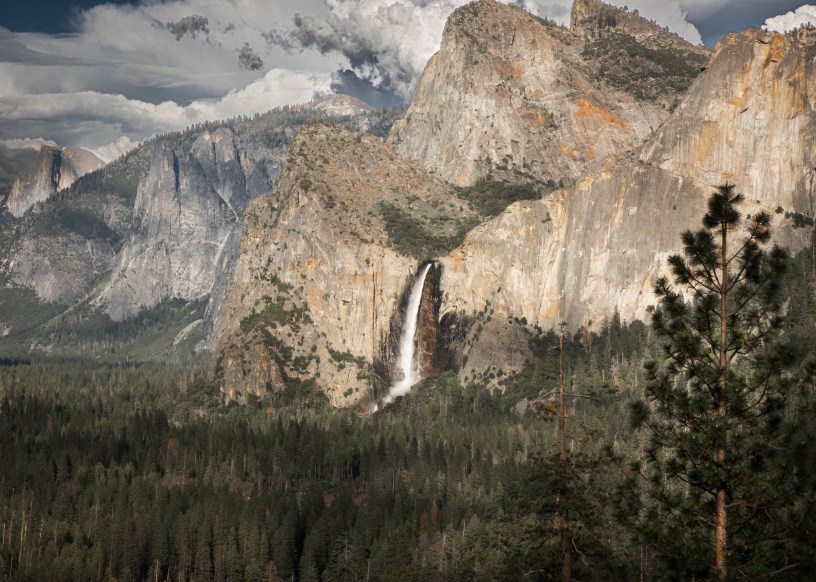
Now, remember, before this romanticized digression, I had just emerged from the Wawona Tunnel. I’d stopped at the Valley Overlook to see what’s probably the most iconic view of Yosemite. This was what I most wanted.
At this overlook, you stand a couple hundred feet above the thickly-treed valley floor. You’re facing east, upriver, up the valley. First to jump out, about two miles away, on the right, is Bridal Veil Falls. Water here falls 620′. This alone is spectacular. This fall alone would cause untold thousands to venture here. However, Bridal Veil is not even in the top ten of Yosemite’s tallest falls.
Opposite Bridal Veil, on the left of the U-shaped valley, stands El Capitan. To steal John Muir’s description, “It is 3,000 feet high, a plain, severely simple, glacier-sculpted face of granite, the end of one of the most compact and enduring of mountain features, unrivaled in height and breadth and flawless of strength.”
From the Tunnel Overlook El Capitan blends into the array of other cresting heaps of granite. The imagination beckons you to stand at its base, and look up, and wonder how insane you have to be climb up this sheer wall, especially without equipment.
In the center, further away, is Half Dome. It’s another massive heap of granite whose natural dome shape has been sawed in half by glaciers which, once upon a time, cut and polished all Yosemite rock. Beyond Half Dome, more mountain tops ascend to the park’s highest country where some mountains peak out over 13,000′ above the sea. On this morning, tiny strips of snow were still visible from where I stood. However, beyond this view, much snow still lay above 10,000′, and would continue to feed those waterfalls well into summer.
To be clear, melting snow causes those waterfalls. Sierra granite does not absorb water. Whatever dirt or moraine there is in the high country absorbs only a small percentage. Some of that water forms small lakes. However, most of it flows downward. Thus, as spring becomes summer, melting snow coalesces into mountain creeks with names like Bridalveil, Horsetail and even Yosemite that fall into the Merced.
Why do those creeks fall so precipitously? Why don’t all the Sierra valleys and canyons have waterfalls like Yosemite? Well, the Yosemite Valley is more U-shaped than V-shaped. A V-shape would have the creeks flow down but not fall down. A U-shaped valley has the sheer drops necessary for waterfalls. John Muir was the first man to propose that glaciers, once upon a time, filled the formerly V-shaped valley, and concentrated their erosion over the whole area which, apparently, widens the valley floor and over-steepens the walls to make that U-shape.
Did this U-shaping dynamic only occur in the Merced River basin of the Sierras? No. The Tuolomne River basin – which is also within the National Park – has waterfalls. Other canyons outside the Park also have them, though, the most famous falls are along the Merced. What geological dynamic caused them to be tallest here? I can’t say.
And, is Muir’s glacier-based explanation correct? Sure. Why not? That’s what geologists say. I’m not knowledgeable enough to disagree here, and I have no reason to. However, I always take geological interpretations with a grain of salt, because there are other areas – like at the Grand Canyon – where I don’t agree with conventional geologists, but more on that later…
Regardless, I was right. Those falls were raging. The winter of 2018 to 2019 was wet and cold for California. It was an El Niño winter. The snowpack on the Tioga Pass – the pass over the Sierras that goes from Yosemite to Lees Vining – was 167% of normal that year. What a perfect day to be here!
The composition of water, trees and rock caused a swell of emotions – all good. In this 6 am-hour, sun rays pierced darkness over the forested valley. Tree tops were becoming golden. Coolness became warmth. I rambled here and there, trying to get the best photo, but, the contrast between light and shadow was too much for my photographic tastes, but so what? Your senses see and feel more than your camera, so, I sat and watched.
It was something else. For three decades I’d yearned to be here. After all, Star Trek 5 came out in June of 1989, and it was now June of 2019. However, of course, it was the many photos I’d seen of Yosemite over the years that were the actual impetus to motivate me here. Ansel Adam’s black and white photo from this exact spot, taken in 1947 and entitled “Clearing Winter Storm,” may be the finest photo ever taken.
And I wondered if today would change me. Would Yosemite cause me to leave Sedona, as Sedona caused me to leave South Texas? I didn’t think it would. However, it’s always fun to entertain the notion of coming upon a place that inspires you to a new life, like Europe, Austin and Sedona all have.
 Charles Torello