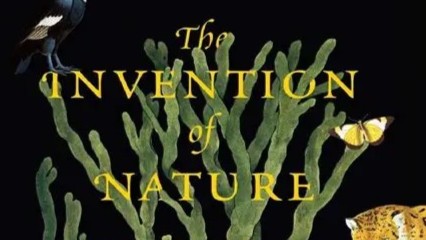
Alexander Von Humboldt is a name that virtually no one recognizes anymore. Yet, in the 19th century, he was almost a messianic figure.
People always forget history’s titans. They do.
Though I myself knew little of Humboldt until finishing the audiobook entitled “The Invention of Nature, ” finishing it allowed me to see how profoundly this man affected my life through the other men whose words I’ve read over the years.
Specifically, it made me realize how much Humboldt inspired a man named Henry David Thoreau, and how much Thoreau once inspired me, and how much I learned in the wake of first reading Thoreau.
By no means am I suggesting that my life reflects any body of thought remotely influential compared to those two names, or anyone else in their wake. But that’s not the point! The point is that even the most mediocre minds can be taught to see things that other’s can’t or won’t.
It is endeavoring to see nature as Thoreau – and his inspiration Humboldt – saw it that has brought joy to my life. Thousands of questions asked, pages read, pages written, hikes hiked, miles driven, photos taken, etc., have all brought me joy because Thoreau taught me how to wonder about the patterns of nature, and how they intersect with each other in ways that excite the imagination.
Humboldt’s explorations of South America and Asia did that too. The observations he made of jungles, mountains, rivers, plants, animals and the sky above them all; and his novel theorizing as to how the interconnections of nature made what he saw so; and the thousands of minds he lit on fire with his words; set the stage for the 20th Century.
He caused an explosion of science and art still with us. He was the First Romantic.
“We are all children of Humboldt” is a phrase that once seemed nebulous. Now it’s 100% crystal clear.
Though modern “science” has evolved beyond the broad, sweeping notions of nature Humboldt once fired imaginations with, and has broken down nature into boxes and paradigms which no longer look at that interconnected whole, I still hold on to his foremost teaching of letting the imagination run a little wild. Why not?
I still think there are new patterns to be discovered. At the very least, there are patterns awaiting my discovery, even though others have already discovered them. Nature teaches the learned and unlearned. It’s inspirational for both. Regardless, if there is one thing adulthood has taught me it is that “scientists” don’t know everything. They’re not gods.
Now, I do see the pseudo pagan aspect of this 19th century glorification of nature – known as the Romantic Era. So many of Humboldt’s Children rejected Christ and His Word. Humboldt himself did. These Romantics sought Supreme Truth in nature, which is arguably a form of idolatry. Many worshiped the Creation and not the Creator.
Nonetheless, the 19th Century’s naturalists, scientists, philosophers, poets, presidents, painters, kings and revolutionaries were taught to see new things because of Alexander Von Humboldt, and we, in the modern world, have forgotten to see those things, especially with visual media so profoundly affecting our perceptions and imaginations.
I myself still want to see them.
Anyway, this “The Invention of Nature” was at times boring. I would have liked to read more of Humboldt’s most salient and fascinating theories. Much of this book was mere biographical recounting. Most wouldn’t like it.
But I did, enough.
 Charles Torello