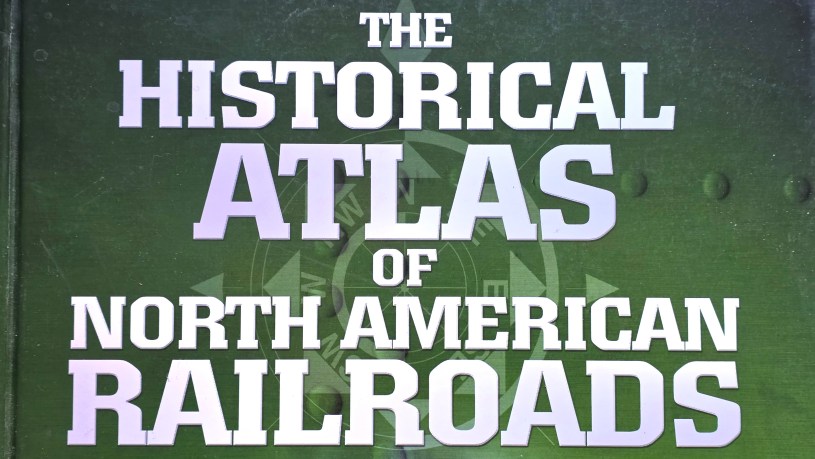
The other day while looking for used underwear at Goodwill, I came across “The Historical Atlas of North American Railroads” for $3.25. I had to buy it.
The older I get, the more I appreciate the role of the railroads in American history. The Iron Horse – and I love that term – integrated this gigantic landmass into one economy like never before seen in all history.
The Lower 48 has an area of 3.12 million square miles. Indeed, the land was rich in natural resources, and there was a ton of land. You can do the multiplication.
But it was the integration of the remote, resource-rich lands into one economy through the railroad that facilitated an efficient exchange of goods and consequent synergy of human action that some have called a 5,000-year leap forward for mankind.
After all, without the railroad’s ability to take remote yet demanded natural resources from an isolated wilderness to distant markets where the money was, those resources would have remained unexploited.
The settlers would not have been able to trade those resources for the money, tools, and other wares they needed to build civilization in the wilderness in the first place.
Those in the big, Eastern markets – Chicago, Boston, New York, Philadelphia, etc – with the capital to fund that settlement wouldn’t have benefited from cheap and abundant resources to construct the powerful dynamo the American economy became.
But the railroad made it all possible.
Think, for example, about the millions of wild cattle on the unsettled West Texas planes. The cattle were far away from the insatiable beef demand in those Atlantic cities, where the money was to compensate crazy cowboys who rounded up wild cattle after the Civil War.
However, because of the railroad, the cowboys knew that if they did round up those beeves, and drove the herds to rail hubs, first in Missouri, and then into Kansas, and then into Texas, they could make money.
And with that money the wild, arid lands westward to the Rockies and beyond could be settled into ranches, towns and cities (along with the help of enough soldiers to whip finally the Comanche and Sioux (and close off those newly settled lands with barbed wire, so all frontiers and open ranges were gone by 1890)).
This fundamental, economic dynamic of creating civilization from the wilderness was the case for countless other remote areas rich with resources.
Think of coal from West Virginia; steel from Pennsylvania; cotton from Tennessee; iron from Michigan; oil from Texas; pork from Iowa; grain from Kansas; timber from Montana; copper from Arizona; silver from Nevada; oranges from California; so on and so forth.
A titanic number of distant resources efficiently came together through the railroad, and made the most prosperous country ever seen. Commerce built America. So fundamental to the story of America is the story of the development of its commerce, and the railroad was arguably the most critical factor.
But there so many details I don’t know. That’s why I bought this book.
 Charles Torello