Maybe you shouldn’t. But maybe you should ‘cuz it’s interesting!
I mean, once upon a time Americans cared about how America became America. They found it fascinating how a titanic civilization was forged from a wilderness. They revered the men and women who made it so because we benefitted in the form of a prosperity never known to the world before. Gratitude alone made people once care.
The role the Erie Canal played in all this is such a uniquely American story.
*
Now, in all seriousness, it’s not my prerogative to tell another man what he should or shouldn’t give his mind to. Again, maybe you shouldn’t give a dang at all. That’s fine.
Furthermore, I do struggle in determining what exactly a people should read about to be historically aware of how their civilization evolved into the present, so, at the very least, they can see its trajectory into the future.
Indeed, a people should be aware of their culture’s evolution because it unequivocally allows you to see the long-term trend of where it’s going. When Hosea said, “My people perish for lack of knowledge,” he was referring to this dynamic of knowing the past to understand the present and see the future.
Which exact books should Americans read to preserve the ideals of a culture that split the atom?
I can think of some. Certainly, the Holy Book containing Hosea’s words is one. But that curriculum is for a different post.
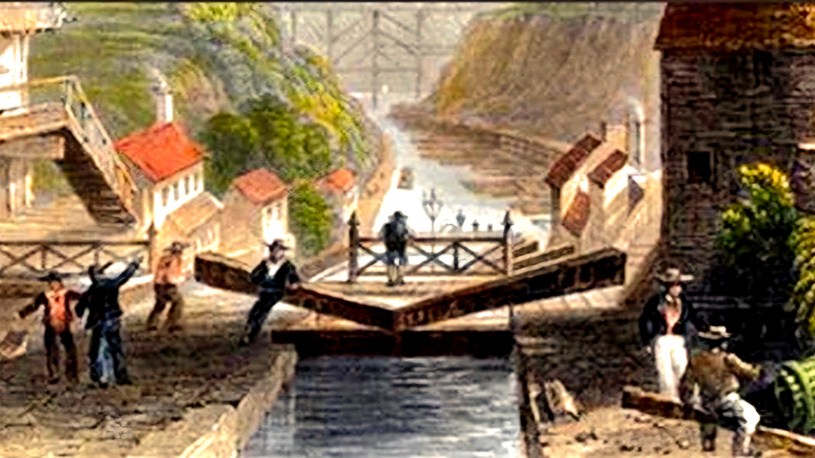
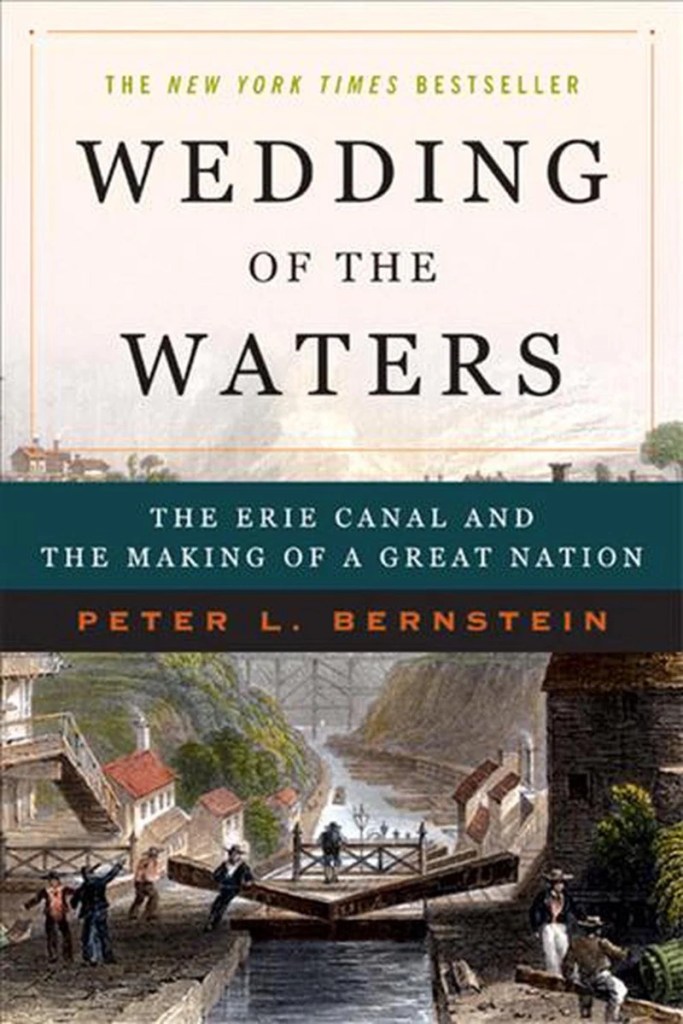
I probably wouldn’t put this book called “Wedding of the Waters” into that core curriculum. But that’s not my point in writing this blog.
My point is to share a source of fascination. I’m reading “Wedding of the Waters” because I want to know the full story behind the Erie Canal. After all, I know it played a critical part in the creation of that most prosperous economy the world had ever seen.
I know the Canal did this because it connected – or “wedded” – the waters of the Great Lakes to that of the Hudson River and thus New York City, the Atlantic Ocean, and the world.
In connecting the Great Lakes by canal to the Atlantic Ocean, there was now an economical means to deliver the agricultural produce of an area bigger than the Ukraine – Western New York, Western Pennsylvania, Ohio, Indiana, Michigan, Illinois and Wisconsin – to ever growing population centers on America’s East Coast – Boston, New York, Philadelphia, Baltimore, DC, etc. – and then onto Europe.
Now, you can ask, “Why was the Canal so important if they could have just transported grain and goods, eastward and westward, over land?”
That’s a good question. The answer is that taking wagons on roads across the Appalachians, which extend from Georgia to Maine, was 1,000 times more difficult and costly. Only a fraction of a fraction of grain and goods could have been transported over wagon roads.
You can ask, “But what about the railroad?”
Another good question. The Erie Canal opened in 1825, 6 years before the first commercial railroad began operating. Even by the end of the 19th century, when transcontinental railroads had connected California to New York, the Erie Canal still was shipping a tremendous volume of goods from east to west. It was still enormously profitable 75 years after it first opened.
“But what about shipping Midwestern products to the Atlantic ports by way of the Ohio River, Mississippi River and Port of New Orleans?”
Yet another good question. The time, cost and risk of such a longer journey was significantly higher than the shorter, cheaper and safer route of the Erie Canal. The Erie Canal was much easier.
Ultimately, using wagons, or using the Mississippi System, or waiting on trains, etc., would have massively hindered the explosion of civilization across North America. Not having an Erie Canal for economic connection between the East Coast and the Interior Planes, and beyond, would have been like filling up a swimming pool with an eyedropper, as opposed to ten garden hoses.
Only God fully knows what would have happened to the United States of America without the Erie canal.
But I do know this… without the Canal, the viability of producing large amounts of agricultural (and other) products from the Midwestern States was just not there. As I said in my recent post about Railroads, without a cost-effective means to take agricultural products from a wilderness to markets where the money and demand is, those agricultural products would never have been produced in the place.
Why grow grain for New Yorkers in Ohio if you can’t get the grain to New York? You wouldn’t, and if you can’t fuel settlement of the wilderness by trading with the part of the country that can give you the goods and wares you need for settlement, you’ll never settle the wilderness in the first place. The wilderness west of the Appalachians would have remained a backwater of the United States for decades and decades, radically altering America’s history.
But that didn’t happen! The Erie Canal incentivized an explosion of growth upon highly fertile land to make the Midwest America’s bread basket. It connected those western lands with the Atlantic States economically, which guaranteed continued political union, as Washington and Jefferson knew that economic isolation of the vast, young Republic would bring about political disunion.
The most interesting aspect of this history, to me, is that Erie Canal made Chicago, and Chicago made all the West. I would argue that the West really began at Chicago, not Fort Worth. But that’s for another post.
Anyways, I want to know more about how all this happened. So I’m reading this book.
 Charles Torello
that is another amazing idea that I believe was god inspired blessings and the knowledge base that inspired the dikes and the gravity the actual size of the chamber for the boats.
LikeLike
Indeed, the engineering behind it all is what I want to learn most.
LikeLike