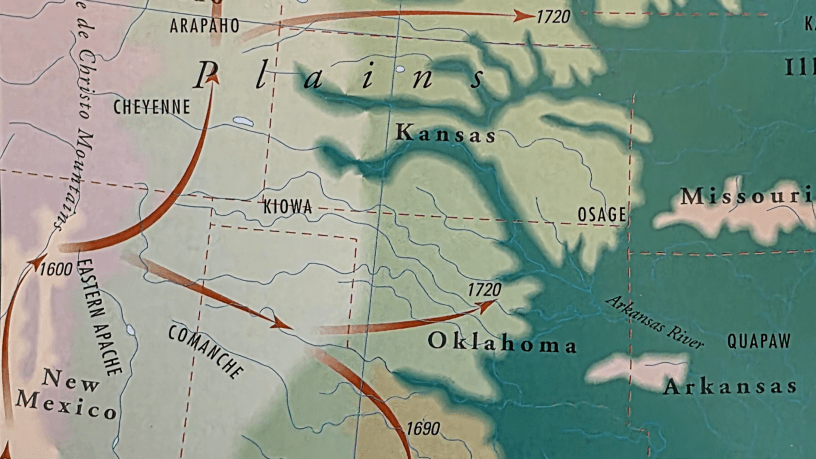
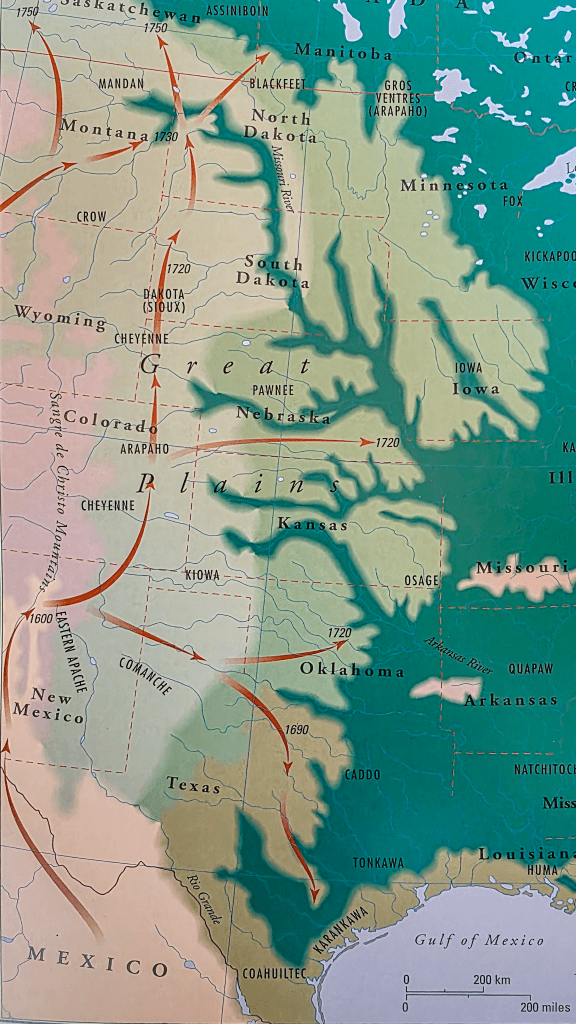
A full history on the dispersion of the horse across North America this blog post will not be.
Really, I’m just here to share a map that I think is neat. It’s from The Historical Atlas of North American Railroads.
To those who don’t know, though a species horse did exist in Ancient North America, it went extinct, along with other North American megafauna, like the wooly mammoth, saber-toothed tiger, and giant sloths, bears, coyotes, etc.
Horses came back to the Americas in 1492, when Columbus brought Iberian horses.
The Spanish, as they built their empire across North and South America, did not want the Indians they conquered to possess the horse themselves. They wanted to deny the Indians any military advantages that the horse would render.
(It is likely the Spanish would not have so quickly conquered the Americas if their Indian rivals possessed horses.)
However, the Great Horse Dispersion began in New Mexico. To those who don’t know, the last of the Spanish Conquistadors – Juan de Onate – arrived in New Mexico in 1598, and laid the foundation for Spanish colonization in the Rio Grande Valley. Pueblos like Santa Fe, Taos, Albuquerque, Santa Rosa, etc., have their foundations in the early 1600’s.
Some say the Dispersion began shortly thereafter. Navajos, Apaches and Comanches would steal horses from Spanish corrals. I’ve read the Apache were the first ones to acquire use of the horse. Others have said Comanche. No one probably really knows.
However, what is known is that on August 10, 1680 the Pueblo Indians of New Mexico united to overthrow Spanish rule, and killed 500 colonists in one day, and sent the Spanish back to El Paso, and, in the process, thousands of Spanish horses were loosed upon the planes and mountains of New Mexico.
Herein was the legendary horse culture of the Great Planes was born. Navajo, Apache, Comanche, Kiowa, Cheyenne, Arapaho, Sioux, and others reinvented themselves to become the legendary horse tribes history remembers them as.
I am glossing over many details. Again, this post was not to give a full history.
It’s to show a neat map, and to make some aware that, once upon a time, even the legendary Comanche were bound to walking, and were pushed around from the Great Basin to the Texas Planes, where, with that Iberian Mustang, they became the stuff of legends.
 Charles Torello
Very Interesting. I did not know any of that, previously.
LikeLiked by 1 person