Look, I’m not a tree-hugger.
I don’t believe in the Mother Earth Goddess; and that mankind is a virus destroying the planet; and that it’s better people die so that Earth can live; and that we should take deliberate steps to limit the population to save Earth.
Indeed, there are people who think like this. There do exist eugenicists who would bring such a world into reality (though their hypocrisy compels them to think that they are not part of the mass of mankind that should die).
I say these seemingly outlandish things because many people who think like this are at the heart of environmental groups.
But I am not one of these people.
I believe in Genesis 1:28, which says:
Then God blessed them [mankind], and God said to them, “Be fruitful and multiply; fill the earth and subdue it; have dominion over the fish of the sea, over the birds of the air, and over every living thing that moves on the earth.“
Nature was made for man. Man wasn’t made for nature. But this is not to say we shouldn’t be good stewards of the land, which God created. Of course we should! We should be good and reasonable stewards.
We must exploit natural resources so we can be fruitful and multiply. Mankind can’t exist otherwise. To punish people for merely living and having babies because you believe you’re hurting the earth by doing so is literally Satanic.
Yet, I firmly we should conserve nature too, because its beauty inspires. That, too, is part of good stewardship. After all, God put man in the Garden of Eden, and certainly God still intends man to experience the benefits of natural beauty He intended for Adam and Eve.
But what is the balance between exploitation and conservation? Between cutting down trees and leaving a forest full? Between drilling wells and letting a river flow? I DON’T KNOW. That’s a huge topic. It’s beyond the scope of what I wish to ask here…
How do you say goodbye to a river?
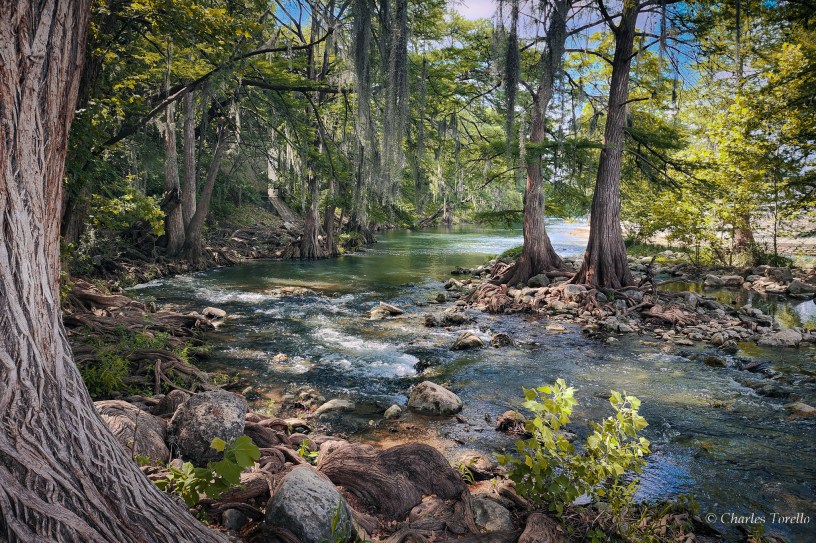
I ask this because there is a river in the Texas Hill Country called the Sabinal that no longer flows.
Well, ok. Below the sand and rocks of the river bed, water still flows. In some places that water flows above the ground, and there the river looks normal.
But in many long stretches of the Sabinal, the river no longer appears to flow. In many places the Sabinal’s riverbed is dry. The water below the riverbed no longer emerges to the surface.
Well, after a heavy rain, the river can flow. But, after a week or so, after the water drains, and those now usually dry sections revert to dryness.
A dry Sabinal has become the norm over the past 10 to 15 years. It used to always flow. Now, not.
Essentially, the acquifer that gives life to the Sabinal, and the other going-dry Texas Hill Country streams, has been depleted to a point where it can no longer give full life to the rivers. They’re disappearing.
Why?
One, its the growth of San Antonio metropolitan area, which depends almost entirely on that aquifer water.
Two, it’s the growth of the population in the Hill Country who are drilling new wells, that now must go almost to 1000′ feet as opposed to a mere 200′.
Three, it’s a terrible long-term drought that has hit the whole Southwest, from Texas to California, beginning, as I recall, in the year 1998 (and the reason for that drought is debatable).
There could be reasons four, five, six and seven too. However, the salient point is that the Sabinal no longer flows. The Frio too is going dry. So is the Guadalupe. So are many other cypress-lined streams, and what are the people of Texas supposed to think about this?
How do you say goodbye to a river?
On the one hand, that’s life. You may as well get used to it. To live in lamentation for a river seems not the best way to live. You just move on.
On the other hand, the rivers are going away. The beauty of the rivers are going away. All the happiness derived from the most beautiful, flowing rivers I’ve ever seen, which brought many people to the Hill Country in the first place, are going away.
Does this mean nothing?
Is it pointless to talk about because we can’t do anything about it? Or, can something be done about it? Does law need to change for the sake of conserving nature’s beauty, even to the detriment of those who think they can use all the water they want, even if that water use seems sinful?
Should water rights in Texas – in the whole Southwest where this is also happening- be redefined?
I can’t speak well to this. Water law is not my expertise. But it’s worth talking about, no?
Am I sad to see the rivers disappearing? I can’t say “sad”. Life will go on.
But it’s a low feeling. It’s a foreboding feeling. It’s a feeling that this is such an unideal state of circumstances with potentially dire consequences that we won’t be able to predict, and to pretend otherwise seems foolish.
What happens when families who’ve lived on their land for decades can no longer draw water from their wells? What if the only way to get water again is redrill their wells now down to 1000′ deep? What if they can’t afford that?
Should they just be required to haul water from elsewhere, like Navajos and Apache in the desert? Is this the moral attitude we should take?
That doesn’t seem right. Plus, I could probably think of other examples of dire consequences to families who’ve had their land for generations. But I’ve made my point.
So how do you say goodbye? I have no idea. But “goodbye” does seem to be appropriate.
 Charles Torello