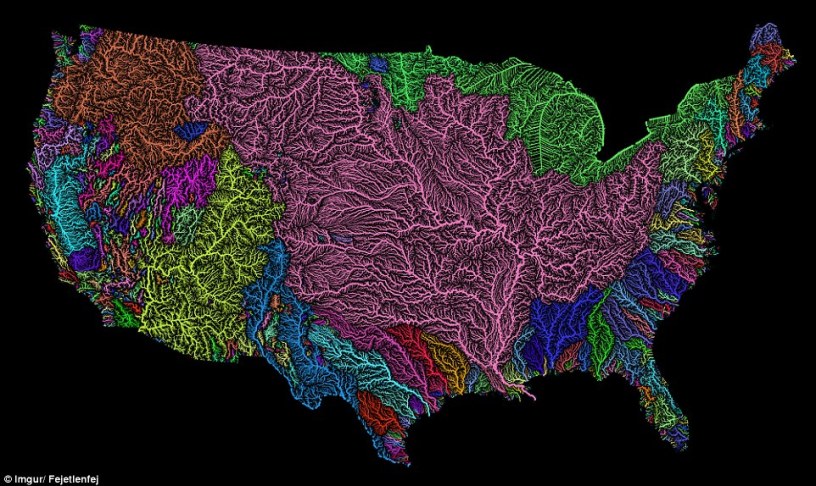
Recently, while driving through the forests of New York and New England, I came across I don’t know how many large rivers.
Now, of course, I’ve come across large rivers before. The Missouri of the Great Planes; the Ohio of the Midwest; the Mighty Mississippi – the Father of Waters – at the heart of America; are all impressive to behold. Even the Colorado of the West can flow with might (sometimes). However, it is the sheer number of rivers you find across New York and New England that impressed me.
New York’s Genessee, Oswego, Mohawk, Black and Hudson Rivers. The Connecticut that divides Vermont and New Hampshire and flows through Massachusetts’s Berkshires Mountains with a volume and beauty that blew me away. Then you have the Concord, Merrimac, Kennebec, Penobscot, and other lesser known but still impressive rivers that all evince a land so amazingly well-watered.
I do wonder what emotions went through the first Europeans who came to this land as they imagined a new civilization growing from such a green and forested place. Certainly, their emotions were a mix of awe and excitement. Fear was undoubtedly there too (especially of Indians).
Yet, civilization flourished. The water that gives life to those rivers also gave life to agriculture and commerce that now provides for over 35 million people of New York and New England. Those imaginative pioneers certainly did help make a new civilization called the United States of America – as did Pennsylvanians, Virginians and the others in the well-watered states along the Atlantic Ocean.
Water is life. Where it flows abundantly, greenery abounds. Forests abound. My imagination has yet to extricate all inspiration emanating from the Great Eastern Forest, which could not exist without ALL the waters and rivers across this part of North America, from the Texas Colorado to the Saint Lawrence, where over 200 million people now live.
(I’d bet those pioneers had no idea how large a change to Earth they were making.)
Anyways, how different this Great Forest is compared to, say, the Coconino and Kaibab ponderosa pine forests of Northern Arizona!
Whereas springs, streams, creeks, ponds, lakes and, again, rivers, bless the land mightily east of the Father of Waters (and a bit westward too), you will find virtually none of them in the Northern Arizona forests.
Well, ok, in Eastern Arizona, in the White Mountain country, rivers like the Blue, Black and White flow southwest towards Phoenix, and within that country you can find ponds, lakes and flowing streams that invite fishermen. (Though, it’s not like New England.)
But the further west you go in that 5,000-plus square-mile ponderosa forest of Norther Arizona, and the closer to Flagstaff you get, the more water disappears, and the pine country becomes so dry that you may as well be walking through a desert.
Especially west of Flagstaff, and south of Grand Canyon, for most of the year not a drop is to be found ANYWHERE.
Indeed, the vast Arizona greenery betrays your basic understanding of land. But the Northeast doesn’t.
All those rivers really are something else, to me.

