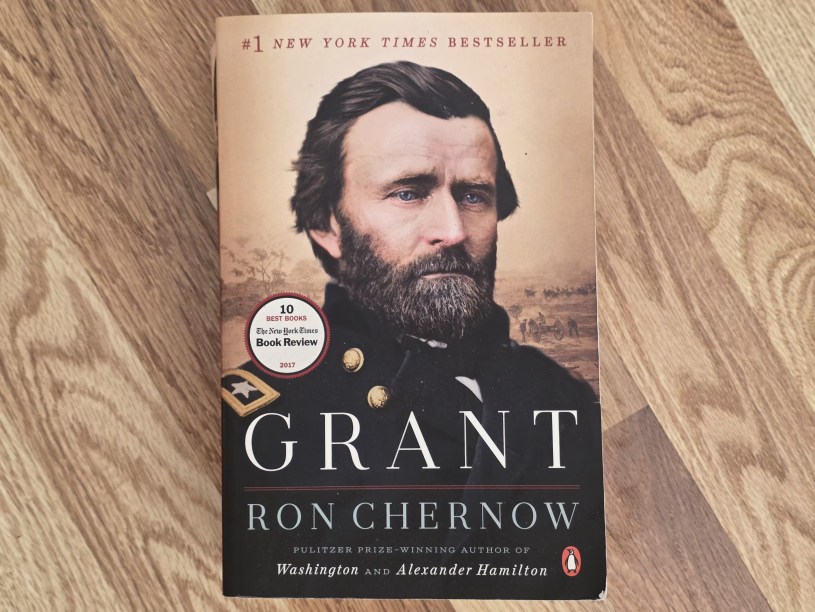
I bought this 2 days ago for $3 at the Sedona library’s used bookstore. I don’t trust author Ron Chernow. However, his narration of facts thus far seems to be good. You should always be able to read between the lines. Just because a man writes a book doesn’t automatically make him the sole authority on any matter. Men twist history all the time.
Regardless, why care about Grant? Well…
He was a simple Ohio farm boy with humble beginnings who rose to a level of power no one expected. He showed courage in the Mexican War, and by sheer will he won battle after battle, and wrested control of the western theater of operations during the Civil War. His victories which secured the Cumberland, Tennessee, Ohio and Mississippi valleys wasn’t expected of a man who was working as a clerk in Illinois when the war began.
Now, Abraham Lincoln had seen general after general – McDowell, McClellan, Burnside, Meade, etc. – fail to take a furious initiative against Robert Edward Lee’s Army of Northern Virginia for the first three years of the war. Lincoln knew that the strategy necessary to defeat the South was to apply maximum pressure on all fronts, especially from Georgia to Virginia, and win by attrition. To “win by attrition” is to win by being willing to lose the same number of men as the Confederacy, knowing that the Union could replace those men, whereas the Confederacy couldn’t.
Such is a bit horrific to consider. I’m no fan of Abraham Lincoln. I believe he was a tyrant who contrived a lot of gobbledygook, like the Orewllian doublespeak of the Gettysburg Address, to justify a war against a people who had every right to secede, as that right forever inheres to all mankind.
However, putting aside those warranted questions of history, in terms of winning the war, however just or unjust the means and ends were, it does seem Lincoln’s assessment of how to win was accurate.
Grant was the man to do it. Again, he had a long string of victories in the western theater, and, thus, he was promoted to Lieutenant General, a position that only George Washington had ever had, and was given full control of all the armed forces of the Union from the Atlantic to Texas and beyond. Grant appointed his friend William Tecumseh Sherman to be in charge of all forces in the West, and Sherman was to apply that needed pressure in Georgia while Grant applied it in Virginia.
I’ve known the above history. So, I skipped right to the part of Chernow’s book where Grant takes over the Union Army in March of 1864. Here my knowledge is wanting. I want to read about battles like Spotsylvania and Cold Harbor, which are battles I’m not very familiar with. I want to read about a many battles and dynamics that I have no doubt the meticulous Ron Chernow can teach me. Like…
I want to read about the ups and downs of the morale of the Army of the Potomac. Lee whipped Grant at Cold Harbor on May 31, 1864 – thousands of Union soldiers marched into certain death there under Grant’s orders. How did Grant recover from this? What happened in June, July and August of 1864? How much did Sherman’s capture of Atlanta in September affect Union morale? What about Sherman burning Georgia thereafter? 1864 is when the war was really won, and I want to know more of the details.
I also want to read about the end of the war, especially all the circumstances Lee faced when he realized he could no longer lead his army in April of 1865. I want to read about the conciliatory emotions Grant felt towards Lee and the whole Confederacy. Grant allowed the men of the Army of Northern Virginia to return to their homes with their arms and horses. He didn’t treat anyone like a prisoner or criminal. Did Grant infuriate a lot of people in the North for this? Especially for letting General Lee go?
I want to read about what Grant was doing from the end of the Civil War until his ascension to the Presidency in March of 1869, and I want to read about his actual Presidency, specifically who was influencing him. Reconstruction under Grant did not seem to have the conciliatory attitude Grant displayed towards Lee at Appomattox. What happened to Grant to facilitate this? Or is my understanding inaccurate in the first place?
More questions I could articulate, especially about the Indian Wars out West against the Comanche and Sioux, which occurred under Grant. That’s important history too. However, I suppose what I’m most getting at is that a massive expansion of federal powers occurred before and during Grant’s administration, and I am curious as to how it all unfolded. This expansion forever changed the United States of America, and I don’t regard that change as good.
I suspect Grant may have had a good heart, but that heart was corrupted by alcohol, vanity, and listening to the wrong people. But I’m not sure. So I want to read more about it. That’s why I bought the book.


Chalie,
Hope you enjoy the book and that it answers all of your questions,
Best,
Gary
LikeLiked by 1 person