I originally published this post for Substack, which I don’t use anymore.
I have edited it a bit, and repost it here, because I will invoke some concepts introduced here later on…
* **
By “nature” I essentially mean landscapes where natural flora and elements dominate our senses, especially in the absence of the artificial works of man’s cities. This definition is not perfect. But it should be sufficient for a reading imagination.
And, by the way, nature is liberating. Nature restores us to a more unbounded state which the artificial bounds. Nature restores avenues of sight, observation and perception that are fundamental to the truest aspects of our beings and its surroundings, which I think we lose in the mechanical environment of the city.
Our thoughts and actions conform to the operations of the Machine, that is, to its lights, traffic, schools, offices, stores, homes, etc. We go from box to box to box, and interface far more with electronic screens instead of the sun and air. We lose our humanity a bit for this.
Of course, we have free will wherever we are. That loss of humanity for conforming to Machine reality is not universal or irreversible. I am also not making a moral judgment on city life and city people. I’m just saying some can feel like they’re living inside a machine, and I have perceived that their thoughts are altered not for the better because of this.
But in nature we can escape this. We can slow our minds down and notice things we did not before: trees, clouds, colors, forms and a thousand other natural objects composing the scape before our eyes. These perceptions of our senses can be an interruption to patterns of automated thinking, and this interruption can be pleasurable and therefore beautiful, as the most fundamental aspect of beauty is pleasure.
However, let me ask deeper questions.
Is the pleasure in nature only in the interruption? Is beauty only in the liberation from the ugly? Is not there something fundamentally beautiful about the natural scape itself? About the composition of land and sky itself?
Of course there is. I believe the raw elements themselves, which compose what we call “nature,” are regarded by our senses as viscerally beautiful. Our beings are programmed to find nature beautiful. I believe it started in the Garden of Eden.
Let me introduce the term “biophilia”. As Britannica says, it is…
“…the idea that humans possess an innate tendency to seek connections with nature and other forms of life…[or]... the passionate love of life and of all that is alive…[and]..,that the tendency of humans to focus on and to affiliate with nature and other life-forms has, in part, a genetic basis…”
This sounds good enough. However, because the term biophilia is a scientific term, the scientific mode of today presumes this tendency to seek connection with nature is the result of mankind’s supposed evolutionary past in which plant and animal life meant sustenance and therefore remaining alive. As man’s brain evolved, the life-giving qualities of nature became perceived as beautiful because they were good.
Of course, I say “supposed evolutionary past” because evolution is a mere theory, and a shoddy one at that. Though a debate between creationism and evolution is beyond the scope of this post, biophilia does seem like a real thing. As a creationist – as one who understands the origins of the heavens, earth and man through Chapter One of Genesis – it is my contention that biophilia results not from evolutionary-induced predilections, but rather God-induced predilections.
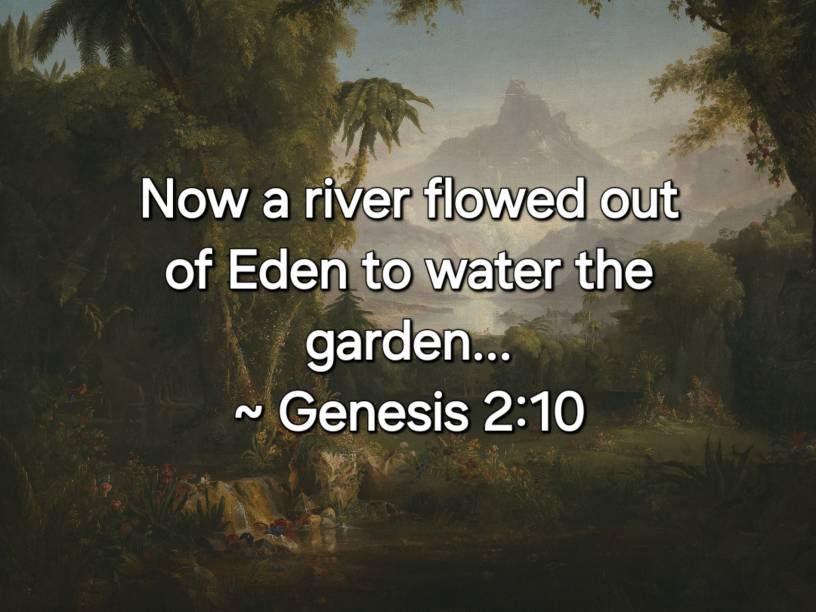
Our Creator did not put man in the City of Eden. He put man in the Garden of Eden, which he PLANTED.
Yes, planted. In the King James Bible, the verb is planted, not created. The plant life of the Garden existed in different patterns outside the Garden. Because a garden is, essentially, a work of art, I can only conclude that, one, God Himself is an artist and, two, God intended man to love nature’s beauty for the sake of helping man to maintain himself pure and free of sin – literally.
Therein, I believe, lies the genetic source of biophilia. From the beginning Man was meant to love nature, especially in the form of God’s Garden. God, not evolution, programmed man to love nature’s beauty, so that he would be more inclined to seek that which is good and true, and, ultimately, continue to be free of sin.
Beauty is a mysterious force that emanates from the mind of God. It exists outside man’s mind. It exists to be perceived by man, like light. I say beauty is of God himself.
Now, some would say beauty is in the eye of the beholder. They would say it is purely subjective, and therefore not something that exists outside man’s mind, but rather something created by it. But I disagree.
Granted, there is some subjectivity to beauty. Some can dislike Gothic architecture or Baroque music or Impressionistic paintings, for example. However, overall, the most esteemed arts all possess traits that make their appeal endure throughout the centuries and even millennia. Their symmetry, form, texture, color, composition, etc, will always appeal to man, and because they will, I argue their traits embody the highest objective standards of beauty.
Modern art appeals now because of warped sensitivities. Its appeal will not endure. The arts of Socrates, Aurelias, Augustine, Aquinas, Michelangelo, Rembrandt, Mozart, Beethoven, Monet, so on and so forth, will. Their works are eternally beautiful. They use true standards of beauty.
You can say this is insufficient argumentation for the existence of objective standards of beauty. However, a full argumentation is beyond the scope of this post, and those reading this likely already agree with what I am saying. So I’ll continue.
Now, because the Garden was to be the eternal setting in which God intended man to live free of sin, and because the Garden was beautiful, it seems logical to think that the Garden’s beauty was specifically intended to help man live free of sin. It seems intentional and not accidental that by satiating man’s mind with beautiful imagery, God hoped to suppress the desire to satiate baser impulses that could have emanated from man’s appetites.
Indeed, I believe that those who appreciate higher perceptions are those who appreciate less lower perceptions. Those who appreciate beauty are more likely to avoid ugliness or baseness. This isn’t perfectly so for all people and the beauty they esteem, but I do assert that correlation exists.
Thus, it only seems to me that beauty satiates man so he can better know virtue and truth and remain pure. Indeed, truth, goodness and beauty seem to be interrelated in that they all lead to each other. That which is true is good and beautiful. Substitute any of the three boldface words for the other two, and I believe the sentence still works.
(Yes, some can say “That which is beautiful is good and true” is not a true sentence, because beauty is subjective, and in the eye of the beholder. But I reject that true beauty is subjective.)
Therefore, I think it’s safe to say that God the Gardening Artist infused man with a love of nature – a biophilia – from the Beginning for the sake of elevating his mind above his stomach, and for the sake of keeping himself pure and free of sin. In seeing the beauty of Creation man would be inclined to wonder about it all, and thus seek the truth of Creation, and the goodness of its Creator.
After all, God called his Creation good over and over again, and then put man, whom God also called good, in that Creation. God intended man to see Creation as good, and therefore turn his heart towards the Creator whose heart is good. In the process, man himself would remain good.
Of course, man would not remain good. His appetites prevailed. He would eat of the Tree of Knowledge of Good and Evil. He wished to be like God, and lost his innocence, and was cast out of Eden. Time and sin came into the world, and now all life dies.
However, biophilia remains. It’s still programmed into our DNA, and I believe the primordial elements of Eden, which man was created to love, still exist upon the earth today. They may be altered or mixed or corrupted, but the elements still exist.
The sun still shines. It warms the cold night, and casts a glow to make colors fluorescent. We experience goodness still in that light.
Water is still H2O and takes the form of oceans, bays, rivers, rain and clouds. All life consumes the water for sustenance, and mankind sees water on the ground and in the sky come together with the light to create ethereal scenery like lakeshores, thunderheads and rainbows.
Earth itself sustains life and is still good. Its miraculous and harmonious balance allows plants, animals and man – for we are not animals as many say – to utilize sun, water and soil to propagate their lives and adorn the land.
I can only believe nature still has an afterglow of Eden. That is why we still find it beautiful. We see God’s creative powers in nature. We see aspects of God Himself in nature.
Thus, we love nature because we were programmed to love nature at the beginning. Our DNA impels us to still love it, and, in spite of nature’s alterations since the Creation and Flood, the raw elements of the Creation still exist in sufficient amalgamations to produce sentiments of beauty and wonder that move our hearts to consider the Creator of it all, and how good He was to give us life from nonlife so that we may know Him, and worship Him, and be with Him when our bodies fail.
But we are not to worship nature. We are to worship nature’s Creator.
FEATURED IMAGE FTOM:


Charlie,
This is quite an article. Very well written and makes a good point. You write very well. Thanks for sending it
Gary
LikeLiked by 1 person
I don’t know if it’s too verbose, or if I repeat myself too much. But, there comes a point where you just post what you think is the result of your best effort.
LikeLike