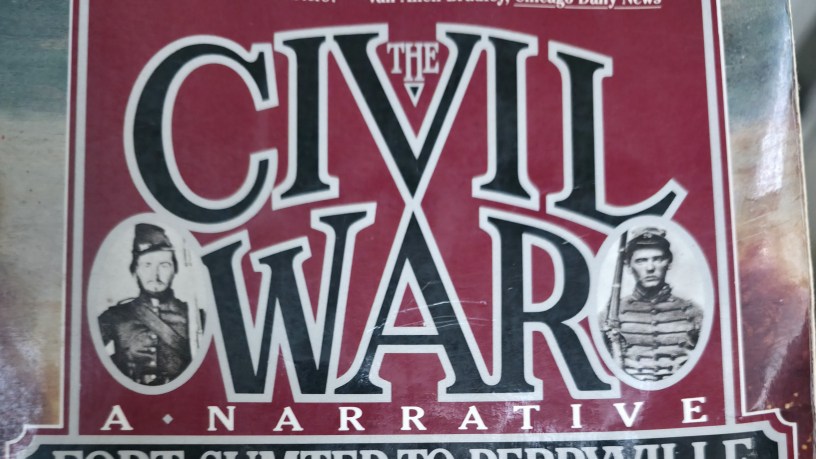
From 1954 to 1974 a Mississippi man named Shelby Foote wrote close to a million words in completing a three volume, nonfiction narrative of the Civil War.
I’ve owned those three books for 15 years. They sat on my bookshelves. I opened one or two from time to time, but never read them. However, now, I’m well into volume one.
It’s astoundingly well written. The way he developed the drama leading up to the First Battle of Bull Run – the first big battle of the Civil War – was fantastic. I couldn’t wait to read how the battle unfolded. His explanation of the battle’s tactics was superb. His description of how a man named Thomas Jackson stood like a stone wall, and turned the tide of battle, and became a legend, was equally superb.
What am I getting at?
Well, Shelby Foote was also a novelist. He wrote fiction too. As he said in an interview from the early 90’s, there is a need for drama to keep the reader turning pages of a book.
By virtue of reading almost 400 nonfiction books on the Civil War, he turned his knowledge into this nonfiction work which is true to events and, of paramount importance, highlights the drama of those events.
After all, there is emotion in every facet of historical life, as there is emotion in every aspect of the present life. Emotion is a core trait of all people, and glossing over emotion is to gloss over the fullest explanations of truth.
Of course there is emotion and thus drama as generals march their armies towards the enemy. There’s drama on the eve of battle. There’s emotion in the soldiers, spectators and Presidents in charge of those generals and soldiers, especially as they eagerly awaited the results of battle, as Abraham Lincoln and Jefferson Davis so waited.
Thus, as Shelby Foote said, it is right to incorporate drama into narratives of historical events. Why would it be wrong to detail if emotion always plays a critical part in determining human action? Why would it be wrong to describe the despair of the North and the elation of the South after Bull Run? What about after Shiloh and Gettysburg and Appomattox?
Details stick better to my mind when the full scope of humanity is explained. You see the full picture. Plus, drama keeps the reader turning pages. It keeps the reader in the state of wanting to learn more. How could this be anything but good?
I guess what I’m really getting at, though, is that so much of modern, academic, historical writing is devoid of drama because academia has poisoned itself with ridiculous notions of its own objectivity. It wants to pretend that modern scholars use the same rigor in articulating historical truths as scientists do in employing the scientific method to articulate scientific truths. But that’s total bullcrap.
Though academics may think they’re being more objective and truthful, all they’re really doing is utilizing language devoid of character and soul, and, basically, it’s terrible. It’s awful. They’re making caricatures of the men who made history, so they can revise history to mean something else. By omitting to explain the full drama of a war into which all men were forced to choose sides, they lampoon the honorable men of the South.
It is thus easier to vilify the South. It is easier to call them white supremacists who only fought because they loved enslaving black people. It’s easier to create villains and heroes because the modern reader cannot possibly know the Spirit of the Times, like North and South both having similar views of blacks and even slavery.
I could continue pontificating. There’s a rabbit hole I’m wanting to dig right now. I’ll save that for another time. My point is that you cannot reduce mankind to formulas without making him look ridiculous, as academics specialize in so doing nowadays when they teach history.
Almost 1 million dead Americans as soldiers and civilians should make anyone with a soul consider what in the hell was really happening from 1861 to 1865. But we believe comic book renditions of history – as the average American’s understanding of the Civil War is like that of a comic book – and supposed objectivity devoid of real humanity seems like a pretty logical reason why.
Victors write histories as propaganda. If you believe propaganda written of the past, you’re far more likely to believe the propaganda for the present.
Anyway, I like Shelby Foote’s book. I like the drama. It’s outstanding, so I spontaneously wrote this post to explain why.

