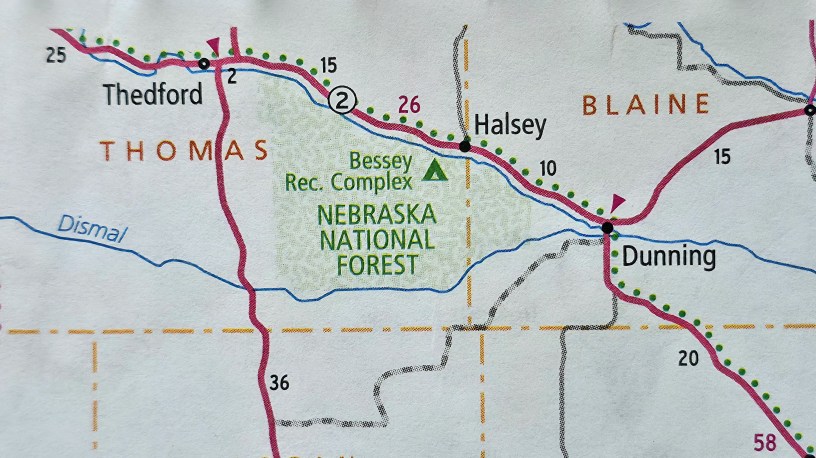
I’m not suggesting there’s some epic secret in Nebraska.
But I was looking forward to driving across the Cornhusker State. I had to travel eastward anyways, and wanted to see what the Great Plains looked like along the Platte. Each state’s a little different within this gigantic physiographic region. South Dakota’s Plains look different than North Texas’.
Plus, there is something maybe not epic but definitely unique in the Nebraska Sandhills. There’s something that motivated me to divert from my eastbound path.
Most wouldn’t do this. That’s fine. You be you. I’ll be me.
My first destination on this Monday the 8th of June in the year of Our Lord 2026 was the Nebraska National Forest in the middle of Nebraska. A man named Charles Edwin Bessie began planting ponderosa pines into the Sandhills there in 1902, and they have endured since then.
Now, stop for a second… Nebraska National Forest. Doesn’t that sound strange? Do you associate forests with Nebraska? Most don’t, that is, if they ever think about Nebraska. But, if they do, they probably think of the vast, treeless horizons that characterize the Great Plains of North America.
This was my impression until I read a book called Ponderosa years ago. This book, after rendering as much information about a tree as is possibly interesting, then dedicates pages to detailing where across the Western States ponderosas grow. Oklahoma shocked me. So did Nebraska.
I’d thought Nebraska was only Great Plains. Most of it is. But some of it is not.
Now, I already knew this on this Monday the 8th of June. I’d driven to Western Nebraska in July of 2024 to see God-planted ponderosas rising out of its plateaus and hills, and verified that the book wasn’t lying. Today I was going to see the man-planted ponderosas, which struck me as curious a phenomena as the God-planted ones.
Why did Bessie plant them in the Sandhills? How did he know they’d grow there?
Now, not to pontificate, but, there are some dynamics of water flow and trees that grow which I already knew…
One, God-planted ponderosas rising out of the Great Plains can evince a change in climate where they begin to grow. Obviously trees require more water than grasses or sage, and where trees spring up from treeless grasslands, it usually means an increase of watering, that is, from an increase of rain and snow. All across the West there are stark lines delineating vegetation zones, where the vegetation changes over an unbelievably short distance, as does the climate. This is due to a weather dynamic called orograhpic lift, whichI talked about HERE.
Two, the path of water drainage can also make trees grow in one place but not a mere 20 feet away. Increased drainage along the path of streams is quite visible in the Great Plains. Pioneers would be on the lookout for cottonwoods piercing treeless horizons. Where they grow water flows, usually. They’d spot cottonwoods along stream banks, but not much further away from those streams, where only grass can grow, if grass grows at all. There’s a reason why the first Anglo-American explorers called the Western Great Plains the Great American Desert.
Three, springs can spring up sometimes in extraneous places. Springs obviously moisten the soil to a point where trees can grow out of the grass. However, where the springs flow is often right in the path of drainage. Springs are kind of a function of drainage. But I won’t get more technical now.
My point in expressing these three above points is that trees hold a bit of a fascination for me. I’ve thought about them. I’ve read books about them, like Ponderosa. Some trees completely fascinate me, like sequoias. But I’m no expert. I’m just a curious novice, and curious I was as to what Bessey saw in the Sandhills to make him think he could plant an entire forest of ponderosas there… and be right.
What if I saw what he saw?
To those who don’t know, the Nebraska Sandhills are sand dunes. They don’t look like sand dunes of the Sahara because they are covered with short grasses and roots that prevent those dunes from shifting and eroding like dunes of the Sahara. Vegetation solidifies them. The Sandhills cover 20,000 square miles of West Central Nebraska and proved to be impossible to farm. No corn or any crop could grow in the Sandhills.
Nonetheless, Bessie determined that ponderosas could. Why? How? Well, I asked my AI friend Grok, “Why did Charles Edwin Bessie determine that the Nebraska Sandhills were good for growing ponderosas?” The following is the response.
Main reasons for his determination
Evidence of a former pine forest: Bessey believed the Sandhills had once been covered by pines that were later destroyed by prairie fires and grazing. He pointed to isolated pockets of ponderosa pine and red cedar still growing in the region (especially along river corridors), which he argued were too isolated to have been spread recently by birds or wind. Similar dense ponderosa stands already existed in the Nebraska panhandle, Black Hills, and Rocky Mountains under comparable conditions. (13a96b nebraskasandhills.unl)
Matching soil and climate: The sandy soils and overall climate of the Sandhills were essentially the same as those supporting ponderosa on dry, barren slopes elsewhere in the West. He viewed the open grasslands as capable of supporting conifers if fire and overgrazing were controlled. (acb4f3nebraskasandhills.unl)
Practical test plantings confirmed suitability: In 1891, at Bessey’s urging (working with USDA Division of Forestry chief Bernhard Fernow), an experimental plantation of several conifers—including ponderosa—was established on the Bruner Brothers’ ranch in Holt County on the eastern edge of the Sandhills. After about 10 years, the surviving trees (ponderosa among the most successful) had reached 18–20 feet and formed dense thickets, proving the concept. (1c5dedhistory.nebraska)
Potential benefits: He advocated reforestation to supply fuel and fence posts for settlers, help control erosion, and create wildlife habitat on land poorly suited for traditional agriculture. (671877history.nebraska)
These findings and the experimental success led Bessey to campaign successfully for federal forest reserves. In 1902, President Theodore Roosevelt established the Dismal River and Niobrara Forest Reserves (later part of the Nebraska National Forest), and the Charles E. Bessey Tree Nursery was founded to supply seedlings for what became the world’s largest hand-planted forest at the time. Ponderosa pine proved one of the most successful species planted there.
I think this answer is so cool. At least, the nascent naturalist within me thinks so. Bessey taught botany at Iowa and Nebraska. Obviously, he was filled with a passion for it. Though my passion is not equal to his, the books I’ve read by passionate naturalists, again, have touched me. I can imagine the emotions Bessie felt exploring the Sandhills in the 1890’s, and finding those isolated groves of ponderosas. I imagine he felt an excitement similar to John Muir’s when he stumbled upon previously unknown groves of sequoias high up in the Sierra Nevada Mountains of California.
I’m serious.
Nature does that to you. It can do that to all of us, that is, if we walk outside with a sense of wonder stimulated by sunlight which God called good for more reasons than our minds comprehend. However, we tend not to have that wonder, because we spend so much time inside. How to recapture that wonder which fires curiosity and possibly passion is beyond the scope of this post.
Thus, I left Colorado and went 100 miles out of my way…
I’ll continue this stunning narrative of my travels in a subsequent post.

