From the Colorado town where I stayed, the Rockies aren’t visible (you gotta go about 40 miles west). It’s flat in Eastern Colorado. Again, it’s Great Plains, and growing up in North Texas taught me to appreciate their horizons, skies and thunderheads. Eastern Colorado has these and the Rockies nearby, so, I wouldn’t complain too much if life brought me to small towns out there.
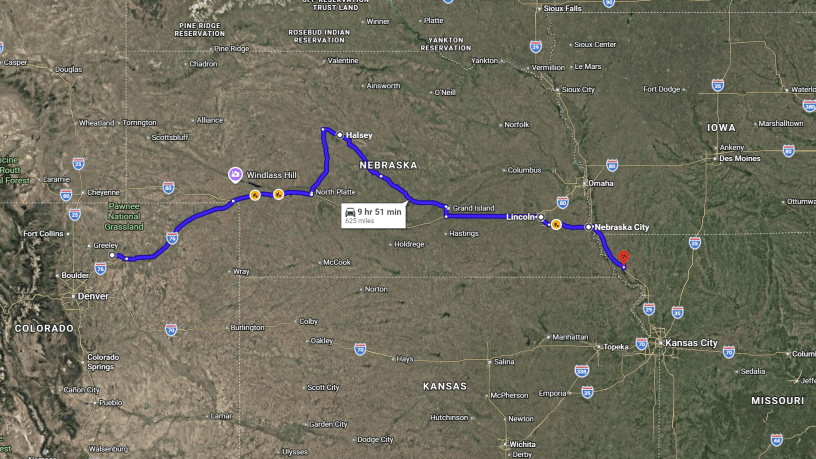
Anyway, into the Plains of Nebraska along I-76 I drove. The next mountains I’d see would be the Adirondacks of New York.
I-76 parallels the South Platte River, which is the river born southwest of Denver and was where golden nuggets were found in 1859. I-76 emerges on to I-80 just inside Nebraska, and I-80 follows the South Platte to the Nebraska town of North Platte. There the North Platte Rver, flowing out of Northern Colorado, confluences with the South Platte. At North Platte, I’d start my diversion northward on US 83.
Storm clouds were gathering north of I-80. It had been weeks since I’d seen clouds and rain. When you live in the desert, clouds are nice. Black clouds are… well… maybe they’d be more menacing today on the Great Plains as opposed to the desert. I didn’t think that these clouds would make tornadoes but what did I really know?
Before too long it was raining. But it was a nice rain. It was soaking but not drenching. A lot of Colorado dust was to rinse off my truck, and cool air from outside ran through the vent with the windows slightly cracked. Everything was cozy.
Then I came across a sign that said “Dismal River.” I imagined the name had something to do with the landscape that didn’t seem so inviting to settlement. Nonetheless, the green, rolling Sandhills under dark skies with patches of light shining through kind of made me wish I would have stopped and take photos. But I didn’t. I was in travel mode, and didn’t feel like scrambling.
Before too long I was on Nebraska Highway 2, which would take me eastward towards Halsey, where the Bessey unit of Nebraska National Forest is. Near Halsey is where that ponderosa forest was planted by Charles Bessey in 1902 (which I talked about in Nebraska National Forest???).
Ponderosas were appearing here and there. I found a road that led me to the “Scott Lookout Tower” and figured the views there would be as good as anywhere. Well, they WOULD have been. The tower was closed. There was a fire that damaged the tower in 2022 and, of course, it would be unreasonable to expect the US Forest Service to have fixed it by now. Four years is not enough time, even with the plethora of competent minds operating that hulking bureaucracy which controls 300,000 square miles of American land.
Look, I don’t want to get completely off subject right now, but I don’t care if I do. The notion that it’s better that the federal government spend billions on weapons for the Ukraine and Israel as opposed to spending that money on America’s decrepitating infrastructure infuriates me. It’s unforgivable. It’s treason.
Now, of course, I know that USFS probably has no power to redirect the flow of funding from war profiteers. I know it has a limited budget, and it says that the vast majority of its allotted funds go toward fighting forest fires. Maybe that’s entirely true. Maybe they can’t squeeze any money for preventative maintenance or fixing fire towers. Maybe most of the USFS personnel would complain like me, perhaps even more.
Is this unequivocally so? That’s what many say, but is it true? Is there no waste? No corruption? No incompetence?
I know enough to know that powerful bureaucrats are bottom feeders on a corrupt federal system, and have no incentive to be competent, especially if there are no consequences for incompetency. Their prime directive is to keep money flowing as it is, and adults with a modicum of common sense know that reformists with pure hearts are squashed by emplaced government systems administering billions of dollars.
Frankly, I think every American has the moral obligation to presume the very worst about the character of anyone in positions of authority. This is the most fundamentally American attitude a man can have. Power always corrupts, and how off-kilter is my thinking when you consider the millions of acres of USFS lands out West that burn every single year? Is this the result of overwhelming circumstances? Is the USFS staffed entirely with good-hearted, competent people who are overwhelmed by circumstances? Is that why they can’t fix a tower? Or is there incompetency and corruption and other evils inherent to all governments in this giant bureaucracy too?
Add to this the fact that Americans seem to be entranced by the nobility of federal agencies that administer land under auspices of protecting it from capitalists who would destroy everything for a buck, which is a complete lie. They’re entranced to love this thing called “conservation” even though they don’t know what it means, which thus disallows them to know whether the federals are “conserving” the land in the first place. Because they’re entranced by supposed USFS nobility and good will, they aren’t critical enough of this powerful federal agency. But they should be.
Something is terribly wrong when we take such a passive attitude to the destruction of our sacred lands – our sacred forests which God or man planted. I say it is a terrible mistake to presume the land is in good hands simply because the federal government claims it is in good hands. Look at the enormity of the destruction! Make no presumptions of benevolence or competency in the face of such destruction!
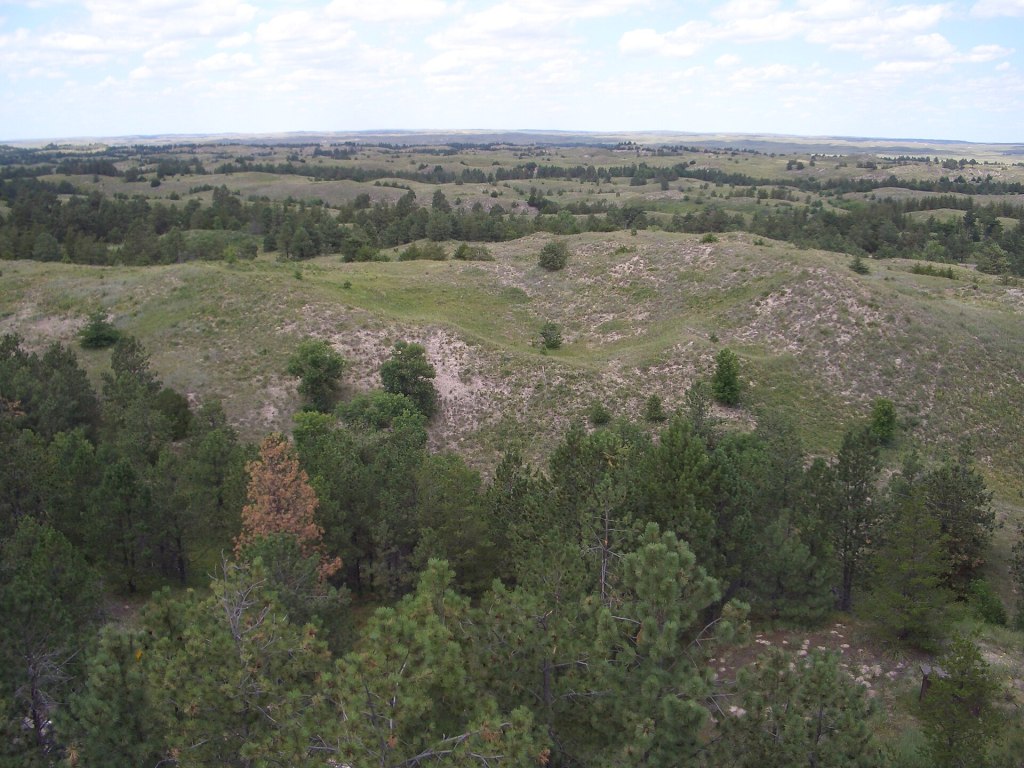
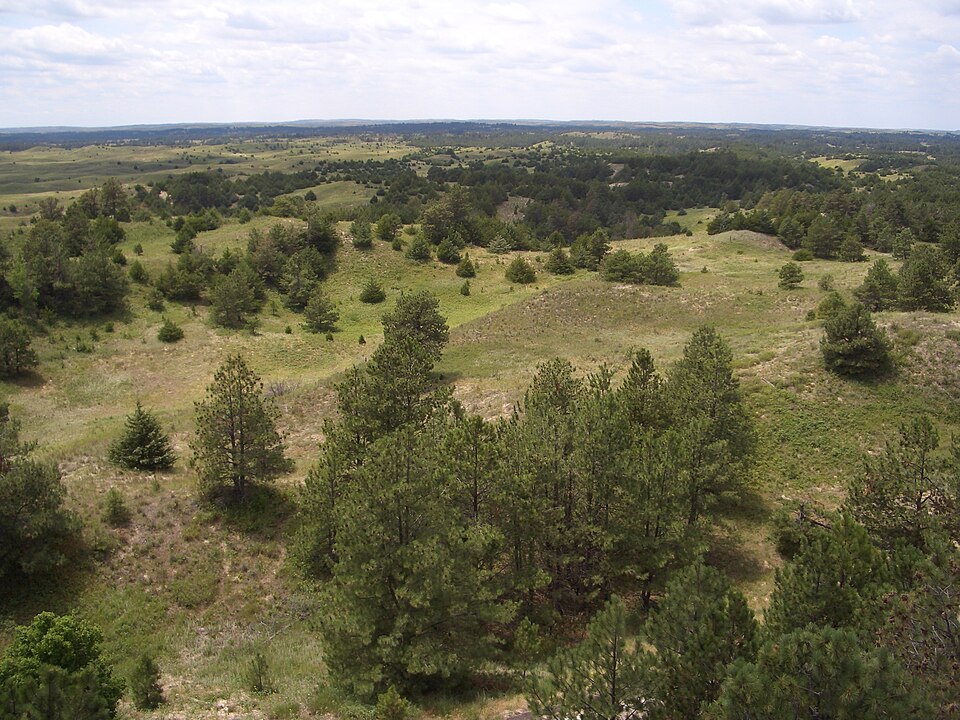
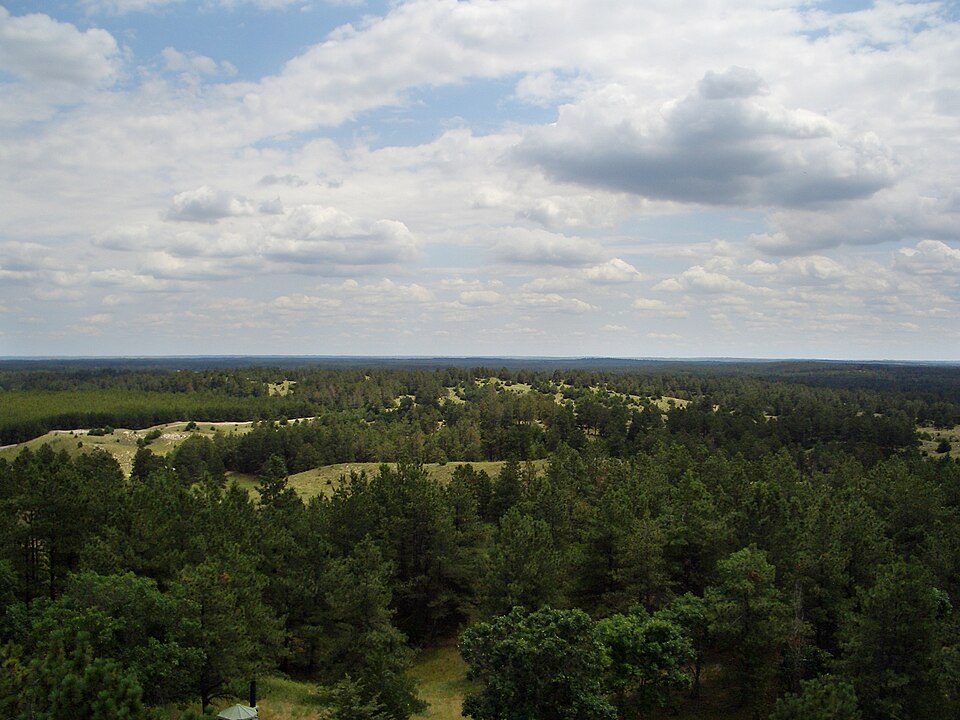
But I will get back to reality now. The actual man-planted ponderosa forest was not a visual wonderland. The trees seemed scraggly and overgrown. The forest seemed more like a dense growth of cedars in Texas. Not especially charming. Ten minutes around Scotts Tower was enough. I didn’t feel like trying to get mediocre photos. The impression of the land had been made. (But I did put three Wikimedia photos of this area at the bottom.)
I got back on NB 2 and headed back to I-80. Had my intention been to get to New York as fast as possible, I would have stayed on I-80 across the Hawkeye State towards Chicago. But such wasn’t my intention. There were other diversions to see from Nebraska to New York.
The next target was St Louis. I’d take 80 to Lincoln, and head more southeasterly from there into the Show Me State.
I did want to pass through Lincoln though, so as to see The Cornhusker Football stadium. The Nebraska Cornhuskers had a special place in my heart while I was playing college football in the 1990’s. They smashed people with their running offense. They were awesome to watch. Of all the college football teams whose uniform I would have been proudest to wear it would have been the Corn Huskers. Overwhelmingly the Huskers.
The stadium was okay. It’s a stadium. Lincoln is a city – but it seemed clean and orderly, unlike other cities. Nebraska, overall, is not a visually stunning place, but that’s not a prerequisite for a good life. Not at all. The people seemed perfectly nice, and from my limited time in Nebraska, I’d rather live there than a lot of other American states.
After a stop at a grocery store for fried chicken I headed for the southwest corner of Iowa, as that was the most direct route to get on I-29, which would take me to Kansas City, where I’d get on I-70 east towards the Gateway City.
By the time I crossed the Missouri River, which forms the border between Iowa and Nebraska, the humidity had massively increased. I’d become unused to humidity in Arizona. Humidity would only get worse as I approached the Mississippi.
But I’d see the Mississippi on the morrow. I was tired at this point. I tried to find a place to camp but, of course, no one answers phones anywhere nowadays. So I pulled into a truck stop north of Kansas City, and slept enough, but not well.