First, coffee. Today would be gas station coffee – a big cup. My hobo coffee generally tastes better. But on the road, I don’t care. Spending 20 minutes under the hot Missouri sun with skeeters biting and trucks roaring made the decision easy. To a gas station I drove.
Plus, uhhh, you know…
On the road I was still listening to the audiobook “The Prize.” The narrative was currently in World War II. Here the book is at its best. Listening to how critical the control of hydrocarbon production was to fuel tanks, trucks and everything else that moves and booms was so cool. As Stalin said, “World War II was a war of octane.” This war forever changed America, and not for the better.
With Kansas City in view, I pulled over for gas, coffee and, you know. By 8:00 am. I was on I-29 southbound again. Before too long I exited onto I-435, which is the loop around Kansas City, and continued south. Off to the west was the Kansas City skyline, and further west over the Kansas Plains was a hot, blue sky. I soon exited I-435 onto I-70, and rolled past the stadiums of the Kansas City Royals and Chiefs. That the Royals and Chiefs play in Kansas City is likely the limit of millions of Americans’ knowledge of this area. Maybe they’ve heard of Kansas City barbecue too. Probably not a ton more.
I’m not insinuating I know a lot more about Kansas City myself. I certainly don’t, and I don’t mean that in any way disrespectful unto the people of Kansas City, on the Missouri and Kansas side. I’d only passed through here a time or two before. It’s never been a deliberate destination.
But I did know that, once upon a time in Missouri, the land that became Kansas City played a tremendous role in sending people west. In the previous post I mentioned how St. Louis was the staging ground for pioneers heading west on the Oregon Trail, but the area around Kansas City is where the Oregon Trail actually started. Around Kansas City the southern bank of the Missouri River was perfect for constructing a dock to unload wagons and goods coming by steamship from St. Louis. Once everything was unloaded, it was time to begin that overland journey to Oregon, California, Utah, Montana and other Western states.
From Kansas City also began another trail that was not as significant in the development of American history as the Oregon Trail. But this other trail did have its day under the sun. I’m talking about the Santa Fe Trail. After Mexican independence from Spain in 1821, authorities in New Mexico allowed the opening of this trail from Missouri to Santa Fe for Anglo entry into the Spanish-speaking Southwest. Fur trappers, merchants, miners and adventurers fired American cupidity for these lands, and, in August 1846, an American Army marched west along the Santa Fe Trail to hoist the flag in the town of Santa Fe and announce that New Mexico was now part of the United States of America. In the 1848 Treaty of Guadalupe Hidalgo, the Empire of Mexico formally ceded the Southwest, from Texas to California, to the Americans. Thereafter the Santa Fe Trail was still used for commerce and settlement, until the Santa Fe Railroad made the Santa Fe Trail obsolete in 1882.
Certainly, more can be said about Kansas City and the Santa Fe Trail – I’d especially like to go on about the Trail. However, on this 9th day of June in the year of our Lord 2026, Kansas City was just a place I had to go through on the way to St Louis. With all due respect to the people there who may consider themselves to live in a fine city, I would say nothing disparaging of your lands. I just don’t know them well.
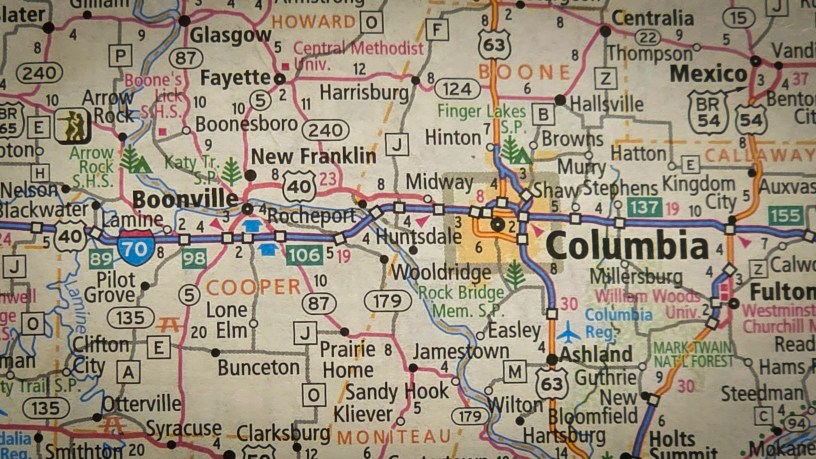
Before too long, I was east of the metropolitan area. My next stop was to be at Columbia. It was two hours away, and I wanted to see where the Missouri Tigers play their college football games. Again, having played college football, there’s always curiosity to see college stadiums. I guess I just like to wonder how I would have felt getting off the buses while feeling the energy of a tens of thousands gathering to watch a game.
Now, approaching Columbia from Kansas City, the Missouri is mostly North of I-70, and beyond the view of the highway. However, the Missouri River curves Southward and parallels I-70 fairly close for over 20 miles right around Boonville, Missouri. Yes, this town is an homage to the famous explorer Daniel Boone who did move to and ultimately die in Missouri, but not Boonville. This town is named after the salt producing operation his son set up in the vicinity.
As the river parallels closely to the interstate, I couldn’t help but to stare at the heavily forested Missouri bottomland- the flat ground stretching out hundreds of yards from the Missouri’s Banks, which gets flooded now and then. The Missouri reminded me of Texas’s Trinity River bottomland, which is the river basin that drains Dallas-Fort Worth. The trees looked similar. A quick AI search said I was right as the bottom lands of both are comprised of cottonwoods, sycamores, hackberries, elms, ashes, alders and oaks.
A lot of Missouri, here, looked like North Texas, to me. The bottomlands of streams are wooded and the higher, hillier terrain above the streams seemed to be a mix of grass, cedars and small deciduous trees. Typical Eastern Great Plains country.
Of course, the further west you go, across Texas, or from Missouri to Kansas, the drier the climate becomes and the scantier the greenery. From Eastern Missouri to Western Kansas – from Illinois to Colorado – there is a massive drop in rainfall and agriculture. You go from some of the best farmland in the world to some of the… well, not the best.
The humidity wasn’t going away – nor did I think it would. A warm, muggy wind blew across my hairy arms from open windows. I keep windows open to appreciate the smell of the wind. It’s an extra sensory detail woven into experiences. Sometimes you only smell diesel exhaust. But sometimes you smell the muddy Missouri bottomland, like when I-70 crosses the river about 10 miles west of Columbia. Again, it was like the Trinity. It had that same muddy smell, and you could feel a drop in temperature over the water.
I couldn’t help but to glance southward while on the bridge to the channel of the river flowing north, and wonder what it would have been like to camp here in June of 1804, when Lewis and Clark were out this way. Lots of mosquitoes probably. Lots of other bugs too. So, I asked Grok when they passed this exact portion of the Missouri, and it said on June 6th. I then looked up their journal entry for that day, and, sure enough, Clark, in his journal, remarked on the salty water in the vicinity that was later exploited by Daniel Boone’s son and gave life to Boonville, Missouri.
I also couldn’t help but to wonder how high, at times, this muddy wilderness lifted the spirits of Lewis and Clark as they ventured upstream into the unknown West, which was so thoroughly unknown that Thomas Jefferson thought they would come across woolly mammoths and other extinct species.
To those who don’t know, 1804 was a year within the Second Great Age of Discovery. Columbus initiated the First Age of Discovery, whose prime directive was searching out the contours of new continents for the sake of finding sea lanes through new oceans back to Europe. The purpose of finding those sea lanes was for trade and empire, and new empires certainly were born. A European world order was born. This First Age lasted, more or less, from 1492 into the 1700’s, when most of the coastlines and trade routes became fairly well known to European explorers.
There is no real definitive date as to when the Second Age kicked off. Regardless, the Second Age was dedicated more to scientific exploration of the still-unknown interiors of the world’s continents. In 1804, the year Lewis and Clark began their fateful journey, there was still a tremendous area of North America unknown to men of science and letters. From St. Louis westward to the Pacific Ocean was largely unknown. That unknown West fired the imaginations of brilliant men as much as the Atlantic did Columbus’. It was largely untrodden by European Civilization and therefore capable of revealing marvels still existing from primordial times – like mammoths and only God knew what else, literally. Lewis and Clark’s Corps of Discovery embodied this Age perfectly.
Indeed, moments of sheer exhilaration fired the hearts of men like Lewis and Clark somewhere along that Missouri River in that month of June 222 years before I was there in June too.
Anyways, before too long I was exiting I-70 onto Providence Road and heading south to see where the Missouri Tigers play. Like the stadium where the Cornhuskers play, where the Tigers play was also a stadium too. It was not stunning or remarkable. I guess I also go to check out stadiums to satiate the curiosity of what the campus and surrounding town would have been like to spend five years of my life within, though never once did I consider putting on the uniform of the Tiger, as I did the Cornhusker.
After a stop at Columbia’s Natural Grocers, for pickles, I got back on I-70, and my next stop would be that Arch.


Charlie,
Another interesting article. I don’t know how you have absorbed and retain such knowledge. As a side note, I was stationed near Kansas City (Richards-Gebaur AFB) a long time ago and knew KC quite well.
LikeLiked by 1 person