It was something that a worker at the Great Smoky Mountains National Park told me a couple years ago.
I’m not promising you’ll find this interesting. But I find it interesting. Actually, fascinating.
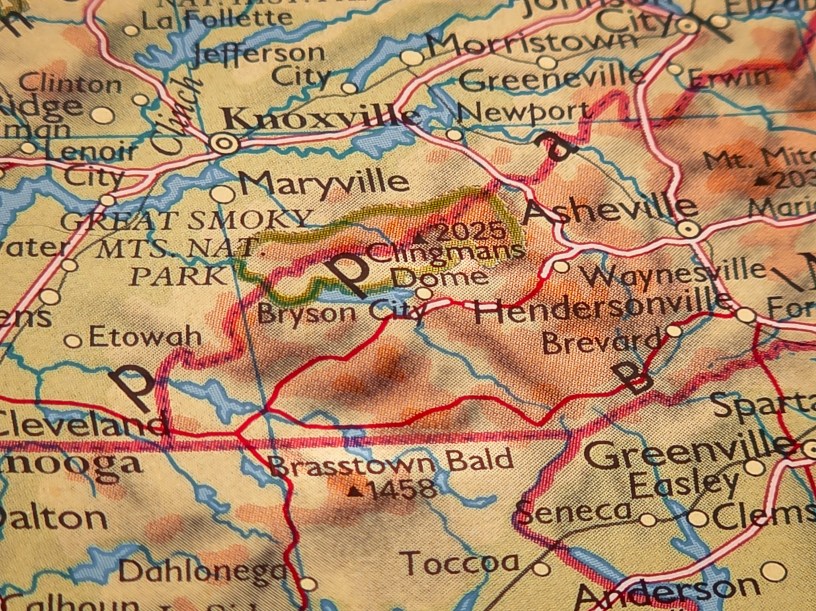
Now, the map above is a photograph of a page in my Oxford atlas. It’s centered upon that National Park. The land encircled by green is the Park. The red line through the Park is the border between North Carolina and Tennessee. At the bottom you can also see South Carolina and Georgia.
The interesting thing the National Park worker told me was that Clingman’s Dome, which is the highest point within the Smoky Mountains National park at 6643 feet (2025 meters) has never had a temperature recorded above 80 Fahrenheit.
Think about it. The south is HOT in summer. Dang hot. Heck, Ohio and Pennsylvania, much further north, can get freaking hot too. I’ve been at Columbus and Pittsburgh for 95 degree days. How does Clingman’s Dome not get hotter than 80?
Furthermore, Flagstaff, Arizona is at 7000 feet. It’s higher than Clingmans Dome. Flagstaff’s all-time high temperature is 97. Flagstaff regularly gets into the low and even mid-90s in summer now.
So why would Flagstaff be hotter than Clingman’s Dome even though it’s higher and therefore should be cooler?
Moisture is the answer. The smokey look of the Smoky Mountains isn’t smoke at all. It’s an almost constant fog hugging the mountains under a sky of equally constant clouds and rain. All this moisture creates a heat shield for the top of the mountain. That’s why the sun’s rays never get a chance to warm the air above 80°.
Again, I think that’s fascinating.
Remember, from the Mississippi River to the Atlantic Coast is a giant forest – the Great Eastern Forest – grown by skies rich with moisture caused by high evaporation from the Mississippi Basin, the Gulf of Mexico and the Atlantic Ocean.
When moisture-rich air masses from near sea-level are orographically lifted to 5000 and even 6000 feet by those Smoky Mountain peaks (and there are 16 peaks within the Park over 5000 feet), that air is cooled; the moisture condenses into fog, clouds and rain; and the temperature remains low.
I suppose this reason is another one why the Great Smoky Mountains National Park is the #1 most visited National Park in America. It’s a perfect place to cool off for 500 miles around.
I’m not trying to advertise the Park. Not at all. I’m just saying that I would like to see it again. I’d like to take my time, and explore the whole greater area, from Georgia to North Carolina to Tennessee and even into Virginia. This area of the Southern Appalachians has the most amount of peaks over 5000 feet, and therefore will have the most dramatic views and weather.
How far beyond the Park borders is that moisture condensation? How far north of Atlanta does it start??
I dunno. Maybe I’ll never go. But I am curious about this, and more.

